
Table of Contents:
- Introduction
- Are Labiaplasty and Vaginoplasty Very Similar?
- What is a Labiaplasty?
- What is a Vaginoplasty?
- Key Differences Between Labiaplasty and Vaginoplasty
- Do Labiaplasty and Vaginoplasty Treat the Same Concerns?
- Recovery After Labiaplasty vs. Vaginoplasty
- Can Labiaplasty and Vaginoplasty Be Done Together?
- How to Know Which Procedure May Be Right for You
- Risks and Considerations of Each Procedure
- FAQs on Labiaplasty vs. Vaginoplasty
- Are the results of labiaplasty and vaginoplasty permanent?
- Will there be visible scars?
- Can childbirth affect the results?
- Can labiaplasty or vaginoplasty be performed after menopause?
- Is there an ideal age for labiaplasty or vaginoplasty?
- Will labiaplasty or vaginoplasty change genital sensation?
- Can these procedures be repeated if the result changes over time?
- Conclusion
- References

Labiaplasty and vaginoplasty are both procedures performed on the female genital area, which is why the two are sometimes mistaken for one another. The confusion is also reinforced by broad terms such as female genital cosmetic surgery and vaginal rejuvenation, which are often used to describe several different procedures. Despite this overlap in terminology, labiaplasty and vaginoplasty involve different parts of the anatomy and are designed to address different concerns. 1
Labiaplasty reshapes or reduces the labial tissue, most often the labia minora, which forms part of the external genitalia. Vaginoplasty, by contrast, involves the vaginal canal and its supporting tissues and is generally performed to address vaginal laxity or restore structural support in tissues that have become stretched or weakened. Although the two procedures may occasionally be combined, they serve different purposes and should not be viewed as interchangeable. Some of the confusion between them stems from the inconsistent terminology used in female genital surgery. ACOG and systematic reviews have noted that terms and outcome measures are not always standardized, which can make it harder for patients to distinguish procedures involving the external vulva from those involving the vaginal canal. 1, 2
Understanding this distinction is important because the choice of procedure depends on the specific anatomy involved and the concern being addressed. A clearer look at what labiaplasty and vaginoplasty each involve helps explain where they differ, where they overlap, and when one procedure may be more appropriate than the other.
What is a Labiaplasty?
Labiaplasty is a surgical procedure that changes the size or shape of the labia, most commonly the labia minora, the inner folds of tissue on either side of the vaginal opening. Although it is often discussed as a cosmetic procedure, patients may seek labiaplasty for aesthetic reasons, functional symptoms, or a combination of both. 1,3 It is important to distinguish labiaplasty as a vulvar procedure, which alters external genital tissue rather than tightening or reconstructing the vaginal canal.

The surgical approach is selected according to the patient’s anatomy, symptoms, and desired outcome. Several techniques have been described, but the trim (edge-resection) and wedge techniques are among the most commonly used. 3,4 With a trim procedure, excess tissue is removed along the free edge of the labia minora. A wedge technique instead removes a section of tissue while preserving more of the natural labial edge. The remaining tissue is then carefully brought together with sutures. Other techniques, including de-epithelialization and variations or combinations of these approaches, may also be used in selected patients. 3,4
There is no single labiaplasty technique that suits every patient. The surgical approach should be tailored to individual anatomy and treatment goals, with care taken to preserve normal function and avoid excessive tissue removal. A 2024 systematic review and meta-analysis found high satisfaction rates across techniques, although complication rates varied between methods. 4
What is Vaginoplasty?
Vaginoplasty is a surgical procedure designed to restore or reinforce the structure of the vaginal canal. In elective genital surgery, it is most commonly performed for women who report vaginal laxity, often following childbirth or age-related changes in pelvic floor and connective tissue support. 1,5 The procedure aims to improve vaginal support by addressing stretched or weakened tissues rather than altering the external vulva. Unlike labiaplasty, which is performed on the external genitalia, vaginoplasty works primarily on internal vaginal structures.
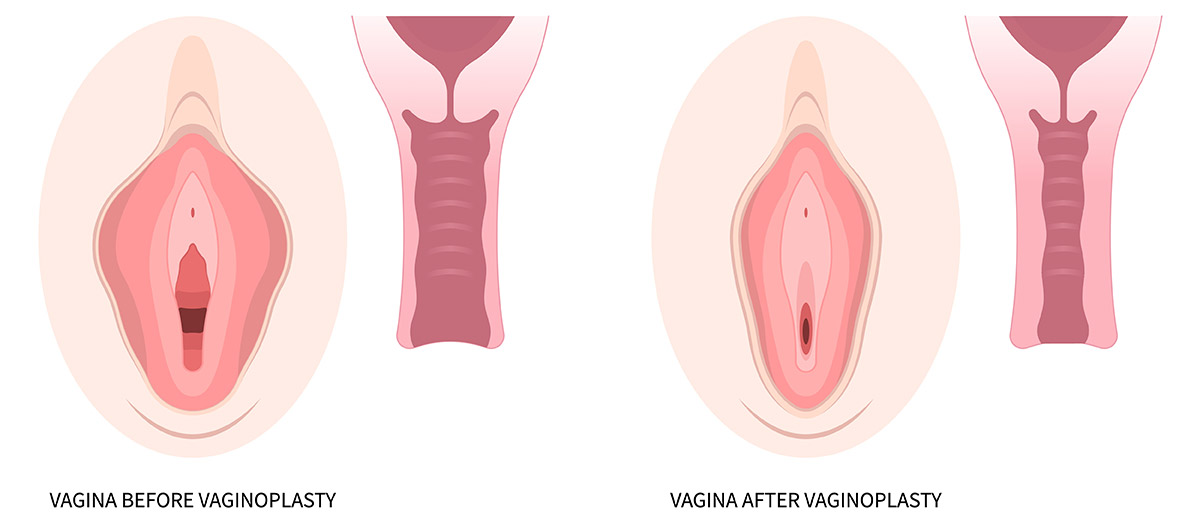
There is no single standardized technique for vaginoplasty, and the surgical approach is typically tailored to the patient’s anatomy and degree of laxity. A commonly described method involves working through the posterior vaginal wall, removing a limited amount of excess tissue where appropriate, and reinforcing the underlying muscular and connective tissue support. 5,6 When laxity also affects the vaginal opening and perineum, perineoplasty may be performed at the same time to repair and strengthen the perineal body and surrounding tissues. The extent of tightening should be carefully individualized, as excessive narrowing or tension may contribute to discomfort or pain during intercourse.6
In practical terms, vaginoplasty is a reconstructive procedure focused on restoring support within the vaginal canal, while labiaplasty addresses the external labial tissues. This anatomical difference is central to understanding why the two procedures serve different purposes despite often being discussed together.
Key Differences Between Labiaplasty and Vaginoplasty
Although labiaplasty and vaginoplasty are often discussed in the same setting, the similarities largely end with their anatomical region. Below are key differences between the two:
Treatment Area
Labiaplasty is confined primarily to the labial tissues of the vulva, most commonly the labia minora.
Vaginoplasty is directed deeper, toward the vaginal canal and its underlying supportive tissues. In other words, one is primarily an external procedure, while the other is predominantly internal.
Goal of Surgery
The objectives also differ. Labiaplasty is performed to change labial size, contour, or symmetry and may address physical concerns such as irritation, pulling, or discomfort associated with prominent labial tissue.
Vaginoplasty is aimed instead at reducing vaginal laxity and restoring support where vaginal and pelvic floor tissues have stretched or separated, particularly following vaginal childbirth.
Surgical Approach
During labiaplasty, the surgeon removes and reshapes selected labial tissue using techniques such as edge resection or wedge excision, with the choice of technique guided by the patient’s anatomy and desired result.
Vaginoplasty requires a different operative approach. Surgery is generally performed through the vagina, where the surgeon may reduce excess vaginal mucosa and reinforce deeper muscular and connective tissues. A perineoplasty surgery may also be added when the tissues at the vaginal opening and perineum require repair.
Extent of Surgery
Labiaplasty and vaginoplasty differ not only in location but also in the depth of tissue they address. Labiaplasty reshapes external labial tissue and does not tighten the vaginal canal, while vaginoplasty works on the vaginal canal and its supporting structures without typically changing the appearance of the labia. This is why terms such as “looseness” or “excess tissue” need to be assessed carefully, as they may refer to very different anatomical concerns.
Scar Location
Labiaplasty incisions are made on the external labial tissues, while vaginoplasty incisions are predominantly within the vaginal canal. If perineoplasty is performed with vaginoplasty, there may also be an incision involving the perineum.
Ultimately, labiaplasty changes the shape or amount of labial tissue, whereas vaginoplasty changes the caliber and structural support of the vaginal canal. They can sometimes form part of the same treatment plan, but they accomplish distinctly different surgical goals.
Do Labiaplasty and Vaginoplasty Treat the Same Concerns?
Not usually. Although both procedures may be considered by women seeking improvement in genital comfort, appearance, or function, they address different underlying problems. Labiaplasty is used when the concern arises from the labial tissues, such as prominence, asymmetry, irritation, or discomfort. Vaginoplasty is intended for concerns related to vaginal laxity and loss of internal support, particularly after childbirth or tissue stretching.
Some patients may have both external and internal concerns, in which case the procedures can sometimes be combined. The key is identifying which anatomical structure is responsible for the symptoms rather than choosing a procedure based on a broad term such as “vaginal rejuvenation.”
Recovery After Labiaplasty vs. Vaginoplasty
Recovery after these procedures is not identical, largely because they involve different tissue planes.
Labiaplasty recovery includes swelling, bruising, and tenderness is expected, particularly during the first week. Sitting for prolonged periods, vigorous exercise, cycling, and anything that creates friction across the vulva can be uncomfortable early on. Many patients are able to resume desk-based work and light daily activities within about one to two weeks, but this does not mean the tissues are fully healed. Swelling can take several weeks to settle, and sexual intercourse is usually postponed until the incisions are well healed, commonly around six weeks.
Recovery after vaginoplasty tends to be more restrictive because the repair extends into the vaginal canal and often involves deeper connective tissue and muscular support. Patients may experience pelvic pressure, aching, swelling, and discomfort with sitting or movement during the early postoperative period. Light activity is gradually resumed, but heavy lifting, strenuous exercise, tampon use, and penetrative intercourse are generally restricted for longer, often for six to eight weeks or until the surgeon confirms that healing is adequate.
An important point is that recovery should be based on tissue healing rather than the calendar alone. A patient may feel considerably better before the deeper tissues have regained sufficient strength. The extent of surgery, whether a perineoplasty was performed, wound healing, and any postoperative complications can all alter the timeline. For that reason, clearance for exercise and sexual activity should come from the operating surgeon after examination rather than from a fixed number of postoperative weeks.
Can Labiaplasty and Vaginoplasty Be Done Together?
They can be combined in selected patients, but there should be a clear reason for performing both. For example, a woman may have bothersome labial tissue as well as vaginal laxity, making it reasonable to address both concerns during the same operation.
The advantage is that treatment can be coordinated within a single surgical and recovery period. However, combined surgery is more extensive, so the decision should take into account the amount of tissue being treated, operative time, healing demands, and the patient’s overall health. The key is not simply whether both procedures can be done together, but whether each one is individually indicated.
How to Know Which Procedure May Be Right for You
The right procedure depends on where the concern is coming from and what you want treatment to achieve. If the issue involves the size, shape, or discomfort of the labial tissue, labiaplasty may be the more appropriate option. If the concern is vaginal laxity or loss of internal support, vaginoplasty may be considered instead.

For some women, the symptoms are not clearly limited to one area, which is why a physical examination matters. The aim is not to choose between procedures based on appearance or terminology alone, but to identify the anatomical cause of the concern and select the treatment that addresses it most directly.
Risks and Considerations of Each Procedure
Neither labiaplasty nor vaginoplasty should be approached as a minor procedure simply because the surgery is elective. Both involve delicate, highly innervated tissues, and the aim is not only to achieve the desired anatomical change but also to preserve sensation, comfort, and normal function.
As with any operation, there are general risks to consider. These include bleeding, hematoma, infection, delayed wound healing, scarring, persistent pain, altered sensation, and the possibility of revision surgery. Adhesions and pain during intercourse may also occur. The type of anesthesia used introduces its own considerations. Nausea, vomiting, or drowsiness are relatively common after general anesthesia, while serious allergic reactions, respiratory problems, or cardiovascular complications are much less common. The individual’s health, the extent of surgery, and the anesthetic technique all influence this risk.
With labiaplasty, concerns include wound separation, hematoma, asymmetry, painful or prominent scarring, and excessive tissue removal. Over-resection deserves particular caution because once too much tissue has been removed, correction can be difficult. It may result in chronic dryness, discomfort, distortion of the labial contour, or pain during intercourse.
With vaginoplasty, the balance is between restoring support and avoiding excessive tightening. An overly narrow or tense vaginal canal may make penetration uncomfortable and contribute to dyspareunia. Other possible complications include bleeding, infection, wound-healing problems, scarring, persistent pain, altered sensation, and the need for further surgery.
Complication risk is not determined by the procedure alone. Smoking, underlying medical conditions like poorly controlled Diabetes Mellitus, medications, previous surgery, and combining several procedures can all influence healing and surgical risk. For either operation, good outcomes depend heavily on appropriate patient selection, realistic expectations, conservative surgical planning, and a surgeon with a detailed understanding of the female genital anatomy. The objective should be a measured anatomical correction, not simply removing more tissue or creating greater tightness.
Labiaplasty and vaginoplasty are elective cosmetic procedures and are typically not covered by insurance. In cases involving a medically necessary component, such as certain instances of vaginal laxity or incontinence, coverage may vary, and patients should consult their insurance provider directly.
FAQs on Labiaplasty vs. Vaginoplasty
Are the results of labiaplasty and vaginoplasty permanent?
Both procedures can produce long-lasting anatomical changes, but the tissues continue to age. Pregnancy, vaginal childbirth, hormonal changes, and changes in tissue elasticity may alter the result over time, particularly after vaginoplasty. Surgery therefore provides a lasting correction rather than a guarantee that the anatomy will never change again.
Will there be visible scars?
Labiaplasty incisions are placed within the labial tissue, and scars often become less noticeable as healing progresses, although scar quality varies between patients. Most vaginoplasty incisions are located inside the vaginal canal, but additional external scarring may be present if perineoplasty is performed. Scarring remains a recognized potential complication of both procedures.
Can childbirth affect the results?
Yes, particularly after vaginoplasty. A subsequent vaginal delivery can stretch tissues that have previously been repaired. Patients who are planning future pregnancies should discuss this with their surgeon when deciding on the timing of surgery.
Can labiaplasty or vaginoplasty be performed after menopause?
Yes, but menopausal changes such as vaginal dryness, thinning of the tissues, and reduced elasticity may affect symptoms, healing, and surgical planning. These factors should be assessed before deciding whether surgery is appropriate.
Is there an ideal age for labiaplasty or vaginoplasty?
There is no single ideal age. Candidacy depends more on anatomy, symptoms, medical history, expectations, and future pregnancy plans than on age alone. Elective genital surgery should generally be deferred until genital development is complete unless there is a clear medical indication.
Will labiaplasty or vaginoplasty change genital sensation?
Temporary changes in sensation can occur during healing after either procedure. Persistent altered sensation is less common but remains a recognized surgical risk, which is one reason careful tissue handling and preservation of normal anatomy are important.
Can these procedures be repeated if the result changes over time?
Revision surgery is possible in selected cases, but it is usually more technically demanding because of scar tissue and altered anatomy from the original operation. The reason for dissatisfaction or recurrent symptoms should therefore be carefully assessed before considering another procedure.
Labiaplasty vs. Vaginoplasty: Final Takeaways
Although labiaplasty and vaginoplasty are often discussed together, they are distinct procedures with different anatomical targets, goals, surgical techniques, and recovery considerations. Labiaplasty focuses on the external labial tissues, while vaginoplasty addresses the vaginal canal and its supporting structures.
The most appropriate procedure depends on the specific concern, the patient’s anatomy, and what surgery can realistically achieve. Careful assessment, realistic expectations, and an individualized surgical plan are therefore essential when considering either procedure.
At Labiaplasty NYC, we offer both labiaplasty and vaginoplasty, with each treatment plan tailored to your anatomy and goals. If you are unsure which procedure may be right for you, we invite you to book a consultation with our experienced team in a private, discreet setting.
References
- American College of Obstetricians and Gynecologists. Elective Female Genital Cosmetic Surgery: ACOG Committee Opinion No. 795. Obstetrics & Gynecology. 2020;135(1).
- Garcia B, Scheib S, Hallner B, Thompson N, Schiavo J. Cosmetic gynecology: a systematic review and call for standardized outcome measures. International Urogynecology Journal. 2020.
- Motakef S, Rodriguez-Feliz J, Chung MT, Ingargiola MJ, Wong VW, Patel A. Vaginal labiaplasty: current practices and a simplified classification system for labial protrusion. Plast Reconstr Surg. 2015;135(3):774-788.
- Géczi AM, Varga T, Vajna R, et al. Comprehensive Assessment of Labiaplasty Techniques and Tools, Satisfaction Rates, and Risk Factors: A Systematic Review and Meta-analysis. Aesthet Surg J. 2024;44(11).
- Austin RE, Lista F, Vastis PG, Ahmad J. Posterior Vaginoplasty With Perineoplasty: A Canadian Experience With Vaginal Tightening Surgery. Aesthet Surg J Open Forum. 2019.
- Furnas HJ, Canales FL. Vaginoplasty and Perineoplasty. Plast Reconstr Surg Glob Open. 2017;5(11).